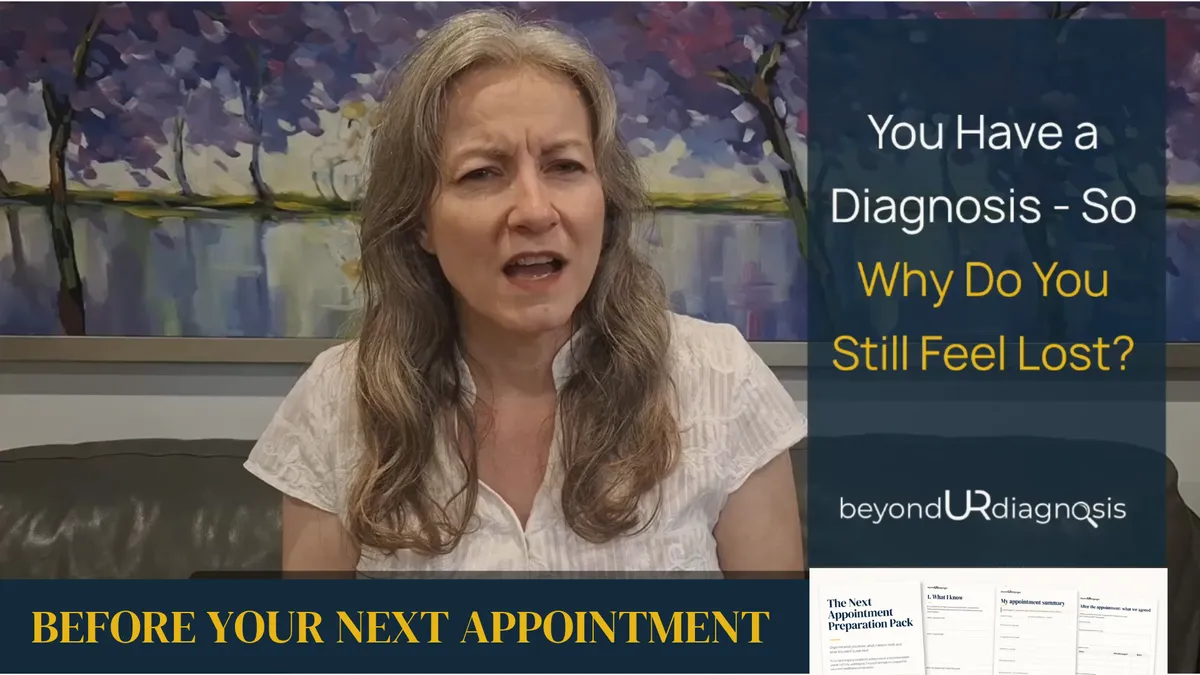
You Have Diagnosis: So why do you still feel lost?
Preparing for a healthcare appointment can feel overwhelming when you have ongoing concerns, unanswered questions or more information than you know how to organise. In this video, Claire Richardson introduces the beyondURdiagnosis Five Parts of Appointment Preparation Framework to help you clarify what you want to communicate and ask next.
Presenter: Claire Richardson Publication Date: 26 October 2026 Duration: 5 minutes 8 seconds
In this video
Separate what you have been told, what you have noticed and what still needs clarification.
Describe the impact on your daily life and identify the priorities you want to discuss.
Choose focused questions for your next healthcare conversation—without needing every answer or a complete medical history.
Your next step
Put the framework into practice
Download the free Next Appointment Preparation Pack for explanations, prompts, a one-page appointment summary and space to record what was agreed afterwards. Start with one concern, describe its impact and identify one question you want help answering.
Download the Appointment Preparation Pack
Prefer guided practice?
Join Before Your Next Appointment on Wednesday 25 November, 6:30–7:30 pm Brisbane time. We’ll work through a fictional example, and you’ll have time to begin your own appointment summary and identify priority questions—without needing a completed workbook, medical records or to share personal health information.
Button: View workshop details
Transcript
Feeling overwhelmed by or underprepared for your next doctor or healthcare appointment?
You may have a diagnosis—but you still don’t know what it means for your next appointment?
What should you explain? What should you ask? And where do you start when there is so much to cover?
Or perhaps you don’t have a diagnosis yet, and you’re struggling to put what has been happening into words.
In this video, I’ll show you the beyondURdiagnosis five parts of appointment preparation framework to help you organise your concerns and choose the questions you want to ask.
You don’t need a complete medical history or every answer before you begin.
I’m Claire Richardson, founder of beyondURdiagnosis and a patient advocacy educator.
Our work focuses on helping women understand evidence, uncertainty and healthcare decisions relating to chronic menstrual health concerns.
I’m not a healthcare professional. This is education to help you prepare for a conversation—not medical advice, diagnosis or treatment recommendations.
Sometimes the difficulty isn’t finding more information. It’s working out what that information means for the conversation you need to have.
An article can describe a treatment without telling you whether it is appropriate for your circumstances. Someone else’s experience can be genuine without predicting yours.
I’ve arrived at appointments with so much going on in my head that I struggled to explain what I needed.
The beyondURdiagnosis Five Parts of Appointment Preparation Framework gives you a way to begin putting that into words.
It’s a practical educational framework, not a diagnostic tool or an independently validated clinical instrument.
Let’s start with one concern—not your whole history.
Part 1: What I know
Separate what you have been told, what you have noticed and what you are wondering.
For example:
“I’ve been told that fibroids may be contributing to my bleeding.”
“I’ve noticed that the bleeding interrupts my sleep and makes work difficult.”
“And I wonder whether something else is contributing to my fatigue.”
Those are three different kinds of information.
You don’t need to resolve the last question yourself. Write it down so you can discuss it.
The aim is a clear starting point—not a complete medical autobiography.
Part 2: What affects my life
A symptom name doesn’t communicate its whole impact.
“Pain” doesn’t explain whether you can sleep, concentrate or complete a workday.
“Heavy bleeding” doesn’t explain whether you avoid leaving home or have to change your plans.
Choose one or two concrete examples of what has become difficult.
This isn’t about proving that you are suffering. It’s about helping another person understand your experience.
Part 3: What is still unclear
What have you heard or read that you still need help understanding?
Perhaps you know the name of a treatment, but not which problem it is intended to address.
Perhaps you understand that there are benefits and risks, but not how they relate to you.
A useful question might be:
“What does this recommendation aim to improve, and what might remain unresolved?”
You don’t need every answer before the appointment. You need a way to identify what needs explaining.
Part 4: What matters to me
Your priorities belong in the conversation.
They might include symptom relief, daily functioning, fertility intentions, concerns about procedures, side effects, cost or time away from work.
You can have competing priorities. You can also be unsure.
“I want improvement, but I need help understanding the trade-offs” is a reasonable starting point.
The goal isn’t to choose a treatment before discussing it. It’s to make your priorities visible.
Part 5: What I need to ask next
Now choose a few questions that matter most to the next conversation—not every question you could possibly ask.
For example:
“What do we know, and what remains uncertain?”
“How do the options relate to my priorities?”
“What happens next, and who will arrange it?”
If other concerns can’t be covered that day, ask how they can be followed up.
Bring it together
Your starting point might be as simple as:
“This is what I’ve been told. This is how it affects my life. And these are the questions I need help answering.”
This preparation cannot guarantee that an appointment will go the way you hope.
You are not responsible for overcoming every barrier to good care by completing a worksheet perfectly.
It simply gives you a way to organise what you want to communicate and understand.
You don’t need to become your own clinician.
To put this into practice, download the free Next Appointment Preparation Pack using the link below.
It includes explanations, prompts, a one-page appointment summary and space to record what was agreed afterwards. There are printable and fillable versions.
Start with one concern. Note how it affects your life and one question you want to ask.
If you’d prefer some guidance while you begin, you can also register for my free workshop, Before Your Next Appointment: How to Turn Health Information Into Better Questions and Clearer Next Steps.
We’ll work through a fictional example, and you’ll have time to begin your own appointment summary and identify priority questions privately.
You don’t need a completed workbook, medical records or to share personal health information.
Download the Pack below. The workshop details are there too if you’d like guided practice.
Corrections Form
Spotted an error or something that needs updating? Use this corrections form to flag an issue or share a relevant source so we can review it. Please don’t include personal medical information.