How to Prepare for a Healthcare Appointment When You Still Have Questions
Making decisions about your care can be difficult when you’re living with a chronic menstrual health condition.
Doctors have limited time in consultations which can feel rushed.
Menstrual conditions are complicated and often the available research may not have clear answers to every question.
Treatments can be life altering with permanent consequences.
Women often encounter conflicting advice online or hear different recommendations from different healthcare professionals.
There are things we can do to help our healthcare team help us make these big decisions, starting with how we prepare for our next conversations with them. It won’t remove all that uncertainty. But it can help you explain what you’re experiencing, identify what matters most to you, and ask the questions you need answered before deciding what comes next.

More questions than answers?
Receiving a diagnosis can answer an important question: What might explain what I have been experiencing?
It may also leave other questions unresolved:
What does this diagnosis mean for me?
Which symptoms does it explain?
What is the recommendation intended to achieve?
What are the alternatives?
How do the options relate to my priorities?
What happens if the first approach does not help?
Having these questions does not mean that the diagnosis is unhelpful or that your care is inadequate. It means that a diagnostic label and a personalised discussion about care do different jobs.
Why more searching may not always create clarity
Searching can help you learn terminology, find reliable resources, and identify questions.
However, an article may describe a treatment in general, without explaining whether it is suitable for your medical history. A personal story may be genuine, without predicting how effective that path would be for you. A research finding may be useful, without answering what should happen next in your care.
The challenge is therefore not simply to collect information. It is to distinguish:
General information you can learn independently.
Questions that need clarification.
Decisions that require individual clinical assessment.
Priorities and circumstances you need to communicate.
It is wise to research your condition and understand the experiences of others with similar diagnoses, but that does not mean you need to become medical degree proficient to ensure you are making the right decisions for you. You do not need to arrive at an appointment with a treatment decision already made. You can arrive with a clearer account of your situation and the questions you need answered.
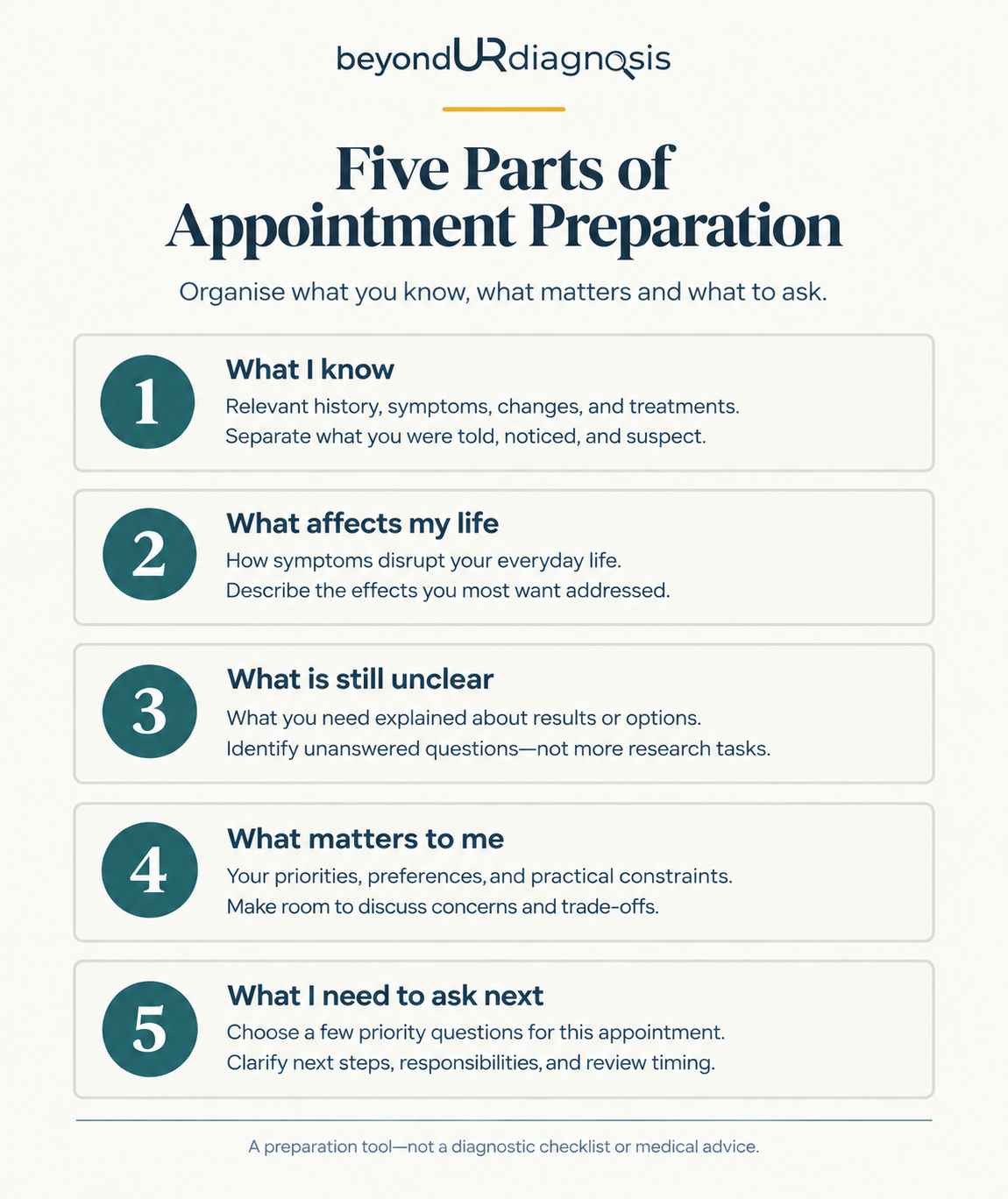
beyondURdiagnosis Five Parts of Appointment Preparation Framework
The beyondURdiagnosis Five Parts of Appointment Preparation Framework is an educational synthesis informed by research on patient-agenda setting and question-prompt lists, alongside shared decision-making guidance. It provides a practical structure for organising information, priorities and questions before a healthcare conversation. The framework itself has not been independently validated.
1. What I know
Start with the information relevant to this appointment:
Diagnoses or working explanations you have gotten.
Symptoms and important changes.
When symptoms began and whether there is a pattern.
Previous investigations and recommendations.
Treatments tried, including perceived benefits and difficulties.
Relevant records and an existing medicines, supplements, and allergies list.
Separate what you have been told from what you have noticed and what you suspect.
For example:
Told: “Adenomyosis was discussed as a possible explanation.”
Noticed: “Heavy bleeding interrupts my sleep.”
Wondering: “What might be contributing to my fatigue?”
This distinction leaves room for your observations without presenting an unanswered question as a confirmed conclusion.
For suspected or confirmed endometriosis, National Institute for Health and Care Excellence (NICE) specifically advises that a pain and symptom diary can aid discussions. The purpose is to communicate your experience—not diagnose yourself.
A concise timeline can also help you explain what has changed. You do not need to reconstruct every day of your health history.
2. What affects my life
A symptom name does not tell the whole story. Describe what the symptom prevents, disrupts, or makes difficult.
Consider:
Work, study or attendance.
Sleep, energy and concentration.
Caring responsibilities.
Movement and ordinary activities.
Relationships and sexual wellbeing.
Emotional wellbeing.
Financial costs.
Activities you avoid or cannot reliably plan.
Compare these two statements:
“My periods are heavy.”
“On heavy-bleeding days, I avoid leaving home because I need frequent bathroom access, and I sometimes cannot complete a work shift.”
The second communicates a practical impact that matters to care discussions.
This emphasis is supported by menstrual-health guidance. NICE recommends that care for heavy menstrual bleeding should aim to improve quality of life rather than focus only on blood loss. The Australian Heavy Menstrual Bleeding Clinical Care Standard also includes quality-of-life impact in the initial assessment.
You do not need to prove that you are suffering. The aim is to describe your experience accurately and identify the effects you most want addressed.
3. What is still unclear
Write down what you need explained. Do not turn every uncertainty into another research assignment.
You might ask:
What does this diagnosis or result mean?
What is the proposed approach intended to address?
Which symptoms might it help, and which might remain?
What options are appropriate to discuss?
What are their possible benefits, harms, and limitations?
How likely are those outcomes for me?
What information would change the recommendation?
The Australian Ask Share Know resource uses three central questions: what are my options, what are the possible benefits and harms, and how likely are those benefits and harms for me?
It is also reasonable to ask about the limits of an investigation.
For example, NICE states that a normal examination or ultrasound does not exclude endometriosis. That does not mean every person with a normal scan has endometriosis; it means the result needs to be understood within the wider clinical assessment.
A useful question is:
“What does this result help us understand, and what does it not rule out?”
4. What matters to me
Your priorities belong in the discussion. They do not replace clinical assessment, but they help your clinician understand the choices and trade-offs you are considering.
These may include:
The improvement you most want.
Concerns about side effects or procedures.
Fertility intentions—or uncertainty about them.
Feelings about retaining your uterus.
Previous healthcare experiences.
Work, caregiving, financial, or transport constraints.
Language, accessibility, or support-person needs.
You may have competing priorities. You can say:
“I want better symptom control, but I am concerned about side effects and time away from work. I need help understanding the trade-offs.”
NICE heavy menstrual bleeding guidance specifically recommends discussing whether someone wishes to retain fertility and/or their uterus. These are related but not identical priorities.
For PCOS, the international guideline recognises a broad range of reproductive, metabolic and psychological concerns, as well as the importance of avoiding weight stigma. Your priorities should not automatically be reduced to fertility or weight.
5. What I need to ask next
Choose a small number of priority questions. Three to five is a practical starting point, not a rule that prevents you from raising other important concerns.
Ask yourself:
"Which answers would most improve my understanding of the next step?"
Useful questions include:
What do we know, and what remains uncertain?
How do the options relate to my priorities?
What should happen next?
Who will arrange it?
When should we review progress?
What changes should prompt earlier medical attention?
If you face a specific difficult choice, an established resource such as the Ottawa Personal Decision Guide may help you identify knowledge gaps, values, and support needs to discuss. It should support—not replace—the clinical conversation.
Use it before and after
Bring one summary—not an entire workbook
Use the five sections to prepare your thinking, then condense your main points onto one page.
Bring:
Your main reason for attending.
Key symptoms, changes, and relevant history.
The effect on daily life.
Your priorities.
Your main questions.
Keep supporting records available separately.
A symptom diary may be helpful where relevant. NHS England’s heavy-period decision resource suggests recording bleeding and how you feel, while Australian endometriosis guidance emphasises a thorough history and individual assessment. Neither requires you to arrive with a self-diagnosis.
Agree the agenda early
Try:
“My main concern today is _. I have a short summary and a few questions. Could we agree what to cover first?”
Patient-agenda research suggests that forms can help bring more concerns into the consultation, but this can also increase consultation time. If everything cannot be addressed, ask how remaining concerns will be followed up.
Ask for an explanation you can use
You can ask for unfamiliar terms to be explained, or for clarification about benefits and risks.
To check your understanding it is helpful to paraphrase what you have just heard:
“To check I have understood, the next step is _. Is that right?”
NICE describes checking understanding through approaches such as teach-back, rather than relying only on “Do you understand?”
If you need time to consider a decision, ask whether it is clinically appropriate to take that time, and when the decision needs to be made.
Record what was agreed
During or straight after the appointment, note:
Agreed actions.
Who will arrange each action.
Timing and follow-up.
Advice about when to seek earlier attention.
Anything still unclear.
You do not need a perfect transcript. You need a usable record of the plan.
What this framework cannot do
It cannot:
Diagnose a condition.
Interpret your medical records.
Determine which treatment is appropriate.
Guarantee that every concern will be resolved.
Remove barriers such as limited appointment time or access to care.
Replace urgent care or personalised medical advice.
Preparation is an option for supporting participation—not an obligation to overcome every difficulty in healthcare.
Download the practical tool
The Next Appointment Preparation Pack includes explanations, prompts, a one-page appointment summary, and space to record agreed next steps.
Download the free pack using the link below. Your completed answers are for you; you do not need to submit them to beyondURdiagnosis.
Download the Next Appointment Preparation Pack
Join the Live Workshop
Want to explore what comes next when a diagnosis does not answer all your questions? Join Claire Richardson for a live beyondURdiagnosis workshop on understanding your situation, identifying what remains unclear, and preparing for better-informed healthcare conversations. It is a practical educational session, not individual medical advice.
Save your place at the live workshop
Want a guided process?
If you want a guided, structured way to build on this process, the getURdiagnosis Course and rebuildURbody Private Online Community are currently open to a small group of Founding Members. The bundle combines educational course sessions and recordings with an ongoing community—not individual medical advice or clinical care.
Explore the Founding Member Bundle
Evidence sources
These sources informed the article’s discussion of consultation preparation, shared decision-making, and condition-specific care. They include clinical guidelines and a care standard, research reviews and studies, and practical patient resources. They do not independently validate the five-part framework or the Next Appointment Preparation Pack.
Clinical guidelines and care standards
National Institute for Health and Care Excellence (NICE). Shared decision making. NICE guideline NG197; 2021. Clinical guideline.
National Institute for Health and Care Excellence (NICE). Endometriosis: diagnosis and management. NICE guideline NG73; first published 2017, with subsequent updates. Clinical guideline.
National Institute for Health and Care Excellence (NICE). Heavy menstrual bleeding: assessment and management. NICE guideline NG88; first published 2018, with subsequent updates. Clinical guideline.
Teede HJ and colleagues. Recommendations From the 2023 International Evidence-based Guideline for the Assessment and Management of Polycystic Ovary Syndrome. Journal of Clinical Endocrinology & Metabolism; 2023. International clinical guideline recommendations.
Australian Commission on Safety and Quality in Health Care. Heavy Menstrual Bleeding Clinical Care Standard. Revised 2024. Clinical care standard.
Research reviews and studies
Kinnersley P and colleagues. Interventions before consultations for helping patients address their information needs. Cochrane Database of Systematic Reviews; 2007. Systematic review.
Stacey D and colleagues. Decision aids for people facing health treatment or screening decisions. Cochrane Database of Systematic Reviews; 2024. Systematic review.
Sansoni JE, Grootemaat P and Duncan C. Question Prompt Lists in health consultations: A review. Patient Education and Counseling; 2015. Research review.
Ramlakhan JU and colleagues. Optimizing the design and implementation of question prompt lists to support person-centred care: A scoping review. Health Expectations; 2023. Scoping review.
Middleton JF, McKinley RK and Gillies CL. Effect of patient completed agenda forms and doctors’ education about the agenda on the outcome of consultations: randomised controlled trial. BMJ; 2006. Randomised controlled trial.
Crump J, Suker A and White L. Endometriosis: A review of recent evidence and guidelines. Australian Journal of General Practice; 2024. Clinical review.
Practical resources
Australian Commission on Safety and Quality in Health Care. Ask Share Know. Patient communication and shared decision-making resource.
Ottawa Hospital Research Institute. Ottawa Personal Decision Guides. Decision-preparation resources.
NHS England. Making a decision about: managing heavy periods. Updated June 2023. Patient decision-support resource (PDF).
Written by Claire Richardson
Claire Richardson is a founder of beyondURdiagnosis. Her work focuses on helping women understand evidence, uncertainty and healthcare decisions relating to chronic menstrual health conditions.
Get the next evidence-based explanation in your inbox
Published: [date]
Evidence sources: 14
Clinical guidelines and care standards referenced: 5
Corrections Form
Spotted an error or something that needs updating? Use this corrections form to flag an issue or share a relevant source so we can review it. Please don’t include personal medical information.